Monday, January 10, 2011

Taman Ayun Temple


Pura Taman Ayun is situated in Mengwi Village of Badung District, around 18 km to the west of Denpasar. It is a very beautiful temple, as the name tells (Taman Ayun  means temple in a beautiful garden). In addition to its beauty, Pura Taman Ayun is also considered to have historical values, which makes the regional government of Bali suggests the UNESCO in 2002 that this temple is included in World Heritage List.

Pura Taman Ayun is a Mother Temple (Paibon) to Mengwi Kingdom. This temple was built by Mengwi King, I Gusti Agung Putu, in the Javanese year of 1556 (1634 AD). Initially, I Gusti Agung Putu built a temple to the north of Mengwi village to the worship of his ancestors. The temple was named Genter Park. When Mengwi grew into a big kingdom, I Gusti Agung Putu moved Genter Park eastward and expand the compound. The expanded temple was officially declared Pura Taman Ayun on Kliwon Tuesday - Medangsia the fourth month in the Javanese year of 1556. Until today, each Kliwon Tuesday of wuku Medangsia in Javanese calendar (Saka), a piodalan (ceremony) is held in this temple to celebrate the temple’s anniversary.

Pura Taman Ayun has gone through a number of restoration works. Large scale restoration was implemented in 1937. In 1949, restoration work was done to the kori agung (the grand room), Bentar temple. A big wantilan was also constructed during the time. The third restoration was implemented in 1972, followed by the final restoration in 1976. Taman Ayun Temple complex is 100 meters in length and 250 meters in width. The complex comprises an outer court and three inner courts. The inner courts, sided with stone fences, have different elevations, and the inner most is the highest one.

The outer court, also known as Jaba, is situated at the outer side of the pool. There is a bridge over the pool to connect the outer court to the inner ones. At the end of the bridge, on the inner court side, there is a Bentar gate followed by a pathway leading to the inner courts. There are two giant statues at each end of the bridge.

At the left side of the pathway, near the gate, there is some sort of a small guardhouse. Here, at the first inner court, there is a Wantilan (a sort of hall) at which some ceremonies usually take place, including a cockfight, which is also part the ritual ceremonies at the temple. There is a pathway lying across the first inner court and dividing it into two parts, connecting the gate into the first inner court to the one into the second inner court. To the southwest, there is a round gazebo at which one can have a rest and enjoy the beauty of the temple. There is a pond near the gazebo covered with water lilies. Right at the center of the pond, there is a small post that sprinkles water to nine different directions. To the east, there is a cluster of small temples called Luhuring Purnama Temples.
   
There is a gate at the end of the pathway dividing the first inner court into two. The gate leads to the second inner court, which is situated on a higher ground than the first one. Across from the gate, on the second inner court, there is a building functioning as a partition. The partition is decorated with relief sculpture depicting nine guardian gods of compass points. To the east, there is a small temple called Dalem Bekak Temple. To the west, around the corner, there is a balai Kulkul with its roof rising high. The third inner court, which is also the inner most and the highest one, is the most sacred area. Its main door, which is called pintu gelung, is placed right in the middle and it is opened only during ceremonies. The main door, however, is flanked by two gates through which people can access the court to do daily routines at the temple. The court houses several Merus, a temple, a Gedong, a Padmasana, a Padma Rong Telu, and other religious buildings.


Temples in Bali


Unlike temples in Java, temples in Bali (called pura), become parts of the life of Balinese who mostly are Hindu. Balinese temple is a place of worship for Hindu. Each Hindu family has family temple to worship Hyang Widhi and their ancestors, so that there are thousands of temples in the island of Bali.

Kahyangan Desa Temple. Each village generally has three main temples called Pura Tiga Kahyangan or Pura Tri Kahyangan (temples of three nirvanas), i.e. temples to the worship of Sang Hyang Widi Wasa in three manifestations of power: Desa Temple to the worship of Brahma (the Creator), Puseh Temple to the worship of Vishnu (the Preserver), and Dalem Temple to the worship of Shiva (the Destroyer). Desa (village) Temple is also called Bale Agung, because the temple, which is usually located at village center, also serves as a venue for village consultative meeting.

Kahyangan Jagat Temple. Kahyangan Temple is a place where common people worship Ida Sang Hyang Widi Wasa in various manifestations and ancestral spirits. Included in Pura Kahyangan Jagat category is Sad Kahyangan Temple (sad = six), i.e. a temple situated in six major Kahyangan in Bali. Sad Khayangan Temples consists of: Pura Luhur Uluwatu, Pura Lempuyang, Pura Goa Lawah, Pura Watukaru, Pura Bukit Pengalengan and Pura Besakih. Pura Sad Kahyangan is believed to be the spiritual vein of for Bali and a center for religious practices. Also included in the category of kategori Pura Kahyangan Jagat, in addition to Pura Sad Kahyangan, is Pura Dhang Kahyangan, i.e. a temple built by spiritual leaders in the past. Pura Luhur Uluwatu is also a Pura Dhang Kahyangan that was built in the 15th century by Dhang Hyang Nirartha.

Pura Luhur. Nearly all districts in Bali have Pura Luhur (luhur = high), i.e. temple whose anniversary is celebrated by followers by staging a piodalan (ceremony) that involves thousands of people. Pura Tanah Lot, Goa Lawah, and Pura Uluwatu belong to this category.

Pura Kawitan. This temple is a place of worship for family or descendants of a particular leader. Temples belonging to this category are: Sanggah-Pemerajan, Pratiwi, Paibon, Panti, Dadia or Dalem Dadia, Penataran Dadia, and Pedharman.

Pura Swagina. This temple is a place of worship for people with particular livelihoods or occupations, for example Pura Melanting for merchants, Pura Subak for farmers, etc.

Thursday, January 6, 2011

Karangnongko Temple

Still on the same day, Friday (26/09/2008) in the last week after visited the Merak (Peacock) Temple , I remember that he said still there is a temple again in the region Karangnongko. By asking Mr Slamet, as the temple guards Merak, we finally get conclusive information about the route to the temple named Candi Karangnongko it. Although Mr Slamet reminds us that the temple is still in the discovery phase of a new alias temple seem basic, but it did not dampen our intention to explore the Temple Karangnongko.

Rice Middle
We departed from the Temple of the Peacock to return to the District Office Karangnongko. There we followed the main road with direction to the south, to arrive at a small intersection with a billboard "Cooperation Unit Trade" on the east side of the road. At the intersection, we took the right direction. We entered a small street just load the rice fields that if passed by two-wheeled vehicles only. We passed the building "Cooperation Unit Trade" which has a strange shape. Not far from the building, Andrew has been kissed "scent" of the temple in the middle of rice fields and indeed our attention then turned to the composition of rocks that are in the midst of rice fields on the east side. But because we parked the vehicle was not at the entrance of the temple complex, then we have to cross the field to get in there.

Still Explore
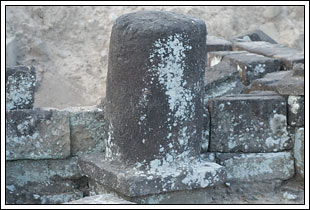
This temple complex had been fenced off by the official BP3 Central Java, but some people still use the temple land for planting crops. We found no statues or stone reliefs in the surrounding area of this temple. The temple is indeed still in the process of excavation (digging). But the old ones no longer seem to have dug up because there are no barracks or workers dig scars there. Of existing conditions, have revealed the position of the main temple is facing towards west. This temple we believe to be the Hindu temple, not least because in the main temple area we found a phallus. In the vicinity of the main temple there are also several rocks arrangement which we believe is part of the main temple or chapel. We look forward to how the later manifestation of this Karangnongko temple when it has been completely refurbished.

 The foundation of the main temple that began to unfold


 The stones of the temple have been discovered.
Among them there is a yoni.


Lingga.the embodiment of male genitalia.