Monday, January 10, 2011

Temples in Bali


Unlike temples in Java, temples in Bali (called pura), become parts of the life of Balinese who mostly are Hindu. Balinese temple is a place of worship for Hindu. Each Hindu family has family temple to worship Hyang Widhi and their ancestors, so that there are thousands of temples in the island of Bali.

Kahyangan Desa Temple. Each village generally has three main temples called Pura Tiga Kahyangan or Pura Tri Kahyangan (temples of three nirvanas), i.e. temples to the worship of Sang Hyang Widi Wasa in three manifestations of power: Desa Temple to the worship of Brahma (the Creator), Puseh Temple to the worship of Vishnu (the Preserver), and Dalem Temple to the worship of Shiva (the Destroyer). Desa (village) Temple is also called Bale Agung, because the temple, which is usually located at village center, also serves as a venue for village consultative meeting.

Kahyangan Jagat Temple. Kahyangan Temple is a place where common people worship Ida Sang Hyang Widi Wasa in various manifestations and ancestral spirits. Included in Pura Kahyangan Jagat category is Sad Kahyangan Temple (sad = six), i.e. a temple situated in six major Kahyangan in Bali. Sad Khayangan Temples consists of: Pura Luhur Uluwatu, Pura Lempuyang, Pura Goa Lawah, Pura Watukaru, Pura Bukit Pengalengan and Pura Besakih. Pura Sad Kahyangan is believed to be the spiritual vein of for Bali and a center for religious practices. Also included in the category of kategori Pura Kahyangan Jagat, in addition to Pura Sad Kahyangan, is Pura Dhang Kahyangan, i.e. a temple built by spiritual leaders in the past. Pura Luhur Uluwatu is also a Pura Dhang Kahyangan that was built in the 15th century by Dhang Hyang Nirartha.

Pura Luhur. Nearly all districts in Bali have Pura Luhur (luhur = high), i.e. temple whose anniversary is celebrated by followers by staging a piodalan (ceremony) that involves thousands of people. Pura Tanah Lot, Goa Lawah, and Pura Uluwatu belong to this category.

Pura Kawitan. This temple is a place of worship for family or descendants of a particular leader. Temples belonging to this category are: Sanggah-Pemerajan, Pratiwi, Paibon, Panti, Dadia or Dalem Dadia, Penataran Dadia, and Pedharman.

Pura Swagina. This temple is a place of worship for people with particular livelihoods or occupations, for example Pura Melanting for merchants, Pura Subak for farmers, etc.

Thursday, January 6, 2011

Karangnongko Temple

Still on the same day, Friday (26/09/2008) in the last week after visited the Merak (Peacock) Temple , I remember that he said still there is a temple again in the region Karangnongko. By asking Mr Slamet, as the temple guards Merak, we finally get conclusive information about the route to the temple named Candi Karangnongko it. Although Mr Slamet reminds us that the temple is still in the discovery phase of a new alias temple seem basic, but it did not dampen our intention to explore the Temple Karangnongko.

Rice Middle
We departed from the Temple of the Peacock to return to the District Office Karangnongko. There we followed the main road with direction to the south, to arrive at a small intersection with a billboard "Cooperation Unit Trade" on the east side of the road. At the intersection, we took the right direction. We entered a small street just load the rice fields that if passed by two-wheeled vehicles only. We passed the building "Cooperation Unit Trade" which has a strange shape. Not far from the building, Andrew has been kissed "scent" of the temple in the middle of rice fields and indeed our attention then turned to the composition of rocks that are in the midst of rice fields on the east side. But because we parked the vehicle was not at the entrance of the temple complex, then we have to cross the field to get in there.

Still Explore
This temple complex had been fenced off by the official BP3 Central Java, but some people still use the temple land for planting crops. We found no statues or stone reliefs in the surrounding area of this temple. The temple is indeed still in the process of excavation (digging). But the old ones no longer seem to have dug up because there are no barracks or workers dig scars there. Of existing conditions, have revealed the position of the main temple is facing towards west. This temple we believe to be the Hindu temple, not least because in the main temple area we found a phallus. In the vicinity of the main temple there are also several rocks arrangement which we believe is part of the main temple or chapel. We look forward to how the later manifestation of this Karangnongko temple when it has been completely refurbished.

 The foundation of the main temple that began to unfold


 The stones of the temple have been discovered.
Among them there is a yoni.


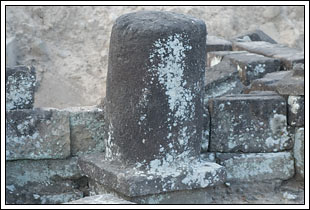
Lingga.the embodiment of male genitalia.

Mantup Temple

Besides Jl. Jogja-Solo connecting the multiple locations of the temple, apparently there is another way in which characterized the same Yogyakarta Jl. Jogja-Solo. The road is the road that connects the city of Yogyakarta with city Wonosari and more popular by the name of Jl. Jogja-Wonosari. The easiest way to reach Jl. Jogja-Wonosari of my house are as follows. On Jl. Jogja-Solo, exactly at the junction Janti, turn to the right to go east Ringroad. In Ringroad east at the first intersection (not the big intersection after the overpass down) turn to the left. Well, until deh on Jl. Jogja-Wonosari.


The location of the temple is surrounded by rice fields.


Temple made of mossy bricks.


There is a kind of cavity for connection. I do not know what does.


Andesite stones we expected as other parts of the temple.


If you continue to browse this way, we'll get Wonosari, a town of Gunung Kidul Regency. But do not worry, because I browsing and Andrew are doing on Thursday (02/19/2008) it does not need all the way down to Wonosari. On Jl. Jogja Wonosari Km 7, on the north road (on the left side of the road if Jogja) is a blue gate that reads Hamlet Mantup. Not far from the gate, there is a plaque of cement concrete pink that read Hamlet Mantup, Baturetno Village, Kec. Banguntapan, Kab. Bantul, Yogyakarta. Just follow the road into the blue gate and about 200 meters on the left side of the road there will be a public cemetery called Segara Madu. Well, at the funeral please park your vehicle and do not be confused if the right-left field all its contents. Not far from the cemetery, in the northwest there is a white board stand upright. It was there Mantup Temple is located.

I do not understand why for the archaeological ruins, some are calling the site and some are calling the temple. For the first time here and imagine that the Temple Mantup is truly the temple in general would be stunned to see the shape of the Temple Mantup. Like in the picture above this article, this temple consists of three buildings measuring approximately 2x2 meters. If the third examined these buildings have some sort of room in it and there is a small entrance into the chamber which faces toward the west. According to sources on the internet, the temple was found identified as Kalyanasundaramurti statue, depicting men and women in positions berdampinngan and holding hands. Allegedly is a depiction of the marriage of Lord Shiva and Parvati. Because of this alleged temple is a Hindu temple and is expected to be built in the 8th century to 9 AD.

We also had a chance to do a little observation on the site this small. Of the three buildings, the only building located on the north side of the brick. Ironically all three buildings were filled with moss. Not far from the entrance to the temple, we found the stones are large andesite we expected as the stone temples. Most of the surface of the stones are still buried in the ground. Because there are no guards who can we ask our sites, we conclude that the temple was found accidentally by a local farmer while plowing the fields. Not only Mantup Temple, because at Jl. Jogja-Wonosari Km 12 was also connected to other archaeological sites. Look forward to continue next article..ok